The destruction of Germany’s Sixth Army at Stalingrad was one of the decisive catastrophes of the Second World War. It is often reduced to a story about snow, hunger, and Soviet persistence. Those forces mattered, but they do not explain why an army that had advanced deep into southern Russia ended up surrounded and destroyed.
The deeper explanation lies in a chain of strategic decisions. German leaders pursued incompatible objectives, treated a symbolic city as an operational prize, stretched their supply system beyond its limits, left exposed flanks to inadequately equipped allied armies, and rejected increasingly clear warnings about a Soviet counteroffensive. Once the encirclement began, an impossible airlift and a refusal to break out transformed a grave military situation into a historic disaster.
A campaign divided against itself
Germany’s 1942 summer offensive was intended to recover the initiative after the failure to defeat the Soviet Union in 1941. The main thrust moved southeast toward the Caucasus and its oil fields, while another force advanced toward the Volga. Stalingrad was important because it stood on a major communications route and because its name gave the city enormous political and symbolic significance.
That combination created a fatal ambiguity. Was Stalingrad primarily a supporting objective whose approaches had to be controlled, or was it a city that had to be captured at any cost? The answer shifted as the campaign developed. Instead of concentrating strength on a single decisive purpose, German commanders divided Army Group South into separate formations moving in different directions. The farther those formations advanced, the longer and more vulnerable their supply lines became.
The German army had achieved its greatest victories through concentration, mobility, and the destruction of enemy forces in open terrain. The 1942 plan weakened precisely those advantages. It required Germany to pursue the Caucasus and the Volga simultaneously, even though neither objective could be secured cheaply.
The wrong battlefield
Stalingrad was a long industrial corridor along the western bank of the Volga, not a compact city that could be surrounded and quickly occupied. Its factories, rail yards, grain silos, workshops, and apartment blocks became fortified zones. Bombing reduced much of the city to rubble, but the rubble favored the defender. Every basement, stairwell, factory hall, and broken wall could become a separate defensive position.
German doctrine was built around movement and coordination in open country. In the city, those advantages diminished. Armor could not maneuver freely, artillery could not always support an attack without endangering friendly troops, and air power was far less effective when Soviet defenders kept their positions close to German units. The result was a battle fought at room-to-room distance, where small groups could resist larger formations for days.
Soviet defenders under Vasily Chuikov understood the value of proximity. By keeping their positions close to the German lines, they reduced the usefulness of German artillery and aircraft while buying time for a larger operation beyond the city. Every German unit committed to capturing another factory or block was a unit not available to secure the open steppe north and south of Stalingrad.
The flanks that made the encirclement possible
The German position depended on long flanks defended largely by Romanian, Italian, and Hungarian formations. These soldiers were not simply unwilling to fight. The central problem was that many of their units lacked the anti-tank weapons, armor, reserves, and logistical support required to withstand a major Soviet armored offensive.
German officers reported the weaknesses. Reconnaissance also detected Soviet troop concentrations. Yet the warnings did not produce an adequate defensive response. Available German mobile formations were already committed in the city or far to the south. The reserves behind the flanks were too few, too dispersed, or too poorly equipped to stop a breakthrough.
This was not one isolated error. It was a structural failure created by the decision to spend the army’s strength on competing offensives while assuming that the enemy would remain too exhausted to exploit the gaps. The Soviet command did not need to defeat the strongest German units head-on. It needed to break the weaker formations protecting their sides.
Operation Uranus and the collapse of the position
On 19 November 1942, Soviet forces attacked north of Stalingrad. Their artillery preparation and armored advance overwhelmed the Romanian positions defending the German flank. The next day, a second offensive began south of the city. The two Soviet thrusts moved toward one another through the rear of the German deployment rather than directly into the urban battle.
On 23 November, the pincers met near Kalach. The Sixth Army and supporting formations were surrounded. The German army had spent months fighting for ground inside Stalingrad while the Soviet command prepared the decisive battle around it.
The encirclement exposed the cost of the earlier decisions. German forces held much of the city, but control of the ruins could not restore an open line to the west. The army needed either to break out quickly or to receive supplies on a scale that Germany could not provide.
The airlift that could not sustain an army
After the encirclement, the German leadership insisted that the trapped force could be supplied by air. The promise was not supported by the arithmetic. The Sixth Army required hundreds of tons of food, ammunition, fuel, medical material, and winter clothing each day. The available transport fleet could not reliably deliver that volume, especially across contested airspace and through severe weather.
Actual deliveries fell far below what the encircled army needed. Airfields were attacked, aircraft were lost, weather interrupted flights, and the starving soldiers lacked the fuel and ammunition necessary to keep their defenses intact. Rations fell sharply. Hunger, disease, exposure, and exhaustion became as destructive as combat.
The airlift was not merely an unsuccessful logistical operation. It prolonged the encirclement while creating the illusion that no immediate withdrawal was necessary. A calculation that should have forced a strategic decision instead became a justification for postponing one.
Why the breakout was refused
A breakout was most plausible before the Soviet ring fully consolidated. General Friedrich Paulus requested permission to withdraw toward the west, but Adolf Hitler ordered the army to remain in place. Several motives reinforced that decision.
Hitler had developed a deep distrust of operational withdrawals after the crises of the previous winter. He believed that holding ground demonstrated willpower and that retreat risked turning an orderly movement into a rout. Stalingrad also had symbolic value: abandoning a city bearing Stalin’s name would be a public defeat. Finally, the German command had become accustomed to treating Hitler’s confidence as a substitute for evidence.
A relief operation under Erich von Manstein later advanced toward the pocket, but it did not reach the trapped army. A coordinated breakout would have required both permission and initiative from inside the encirclement. Neither came in time. By then, the deteriorating condition of the troops made movement increasingly difficult even if the order had been issued.
A command culture that suppressed warnings
Stalingrad cannot be explained by Hitler’s decisions alone, although his responsibility was central. The disaster also reflected the command culture around him. Officers who challenged the expanding plan could be dismissed or marginalized, while optimistic assessments were more likely to survive at the top.
That culture damaged the flow of information. Reports about Soviet concentrations existed, but information is useful only when leaders are willing to accept its implications. German commanders repeatedly interpreted evidence through assumptions about Soviet weakness and German superiority. The Red Army was expected to be exhausted, unable to coordinate large operations, and incapable of exploiting a complex opportunity. Operation Uranus proved those assumptions wrong.
Friedrich Paulus represented the dilemma of obedience particularly clearly. He was a capable staff officer who understood the operational danger, yet he was also a commander shaped by a system in which disobedience to Hitler carried enormous professional and political consequences. When the order was to hold, he held. When the airlift was presented as viable, the army remained in the pocket.
The final surrender and its human cost
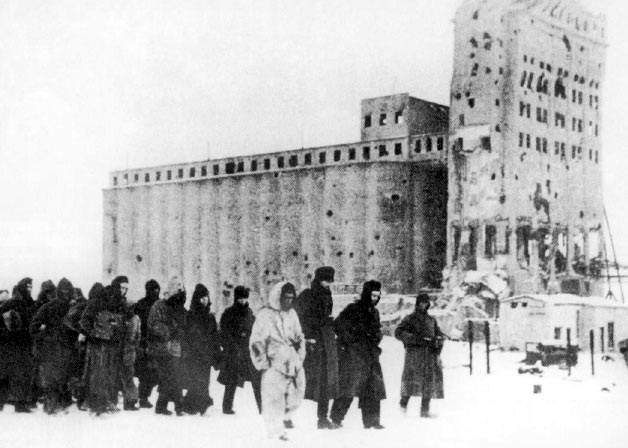
The southern part of the pocket surrendered on 31 January 1943. The remaining German forces capitulated on 2 February. Tens of thousands of prisoners were marched into captivity, and only a small fraction of those captured would eventually return to Germany. The Sixth Army had ceased to exist as an effective formation.
The German regime presented the defeat as a heroic sacrifice. That narrative concealed the avoidable decisions that had placed the army in the pocket and denied it a realistic chance to escape. The scale of the loss made the official story difficult to sustain, even as propaganda attempted to transform strategic failure into martyrdom.
What Stalingrad revealed
Stalingrad demonstrated that tactical skill cannot compensate indefinitely for strategic overreach. Germany’s army could still fight with determination and sophistication, but it could not overcome inadequate logistics, exposed flanks, dispersed objectives, and an opponent whose industrial and operational capacity was rapidly improving.
The battle also showed the danger of confusing past success with permanent superiority. German victories had encouraged contempt for Soviet capabilities and excessive faith in the judgments of a single leader. Evidence that contradicted those beliefs was repeatedly discounted until it became impossible to ignore.
The most important lesson is therefore institutional as much as military. Stalingrad was not caused by one bad day or by winter alone. It emerged from a sequence in which each decision made the next correction harder: divide the offensive, overextend the supply lines, fight for the city, neglect the flanks, dismiss the warnings, reject the breakout, and trust an airlift that could not meet the need.
By the time the guns fell silent, the consequences were irreversible. The Soviet Union had demonstrated that it could plan and execute a large-scale strategic counteroffensive. Germany had lost a major army and, with it, much of the initiative in the East. Stalingrad became the clearest proof that ambition unsupported by logistics, evidence, and disciplined command can turn an advance into a catastrophe.