The destruction of the German Sixth Army at Stalingrad was one of the most consequential defeats of the Second World War. It was also a disaster that developed over months rather than in a single dramatic moment. German commanders made a series of connected decisions that transformed a risky offensive into an encirclement, then turned a dangerous trap into the destruction of an entire army.
The chain began with an ambitious summer campaign, continued through the decision to pursue multiple objectives across an enormous front, and reached its fatal stage when German leaders refused to abandon Stalingrad. By the time the encirclement closed in November 1942, the army inside the pocket had been placed in a position from which recovery would be extraordinarily difficult. The final catastrophe came when its commanders trusted an impossible air-supply promise and waited for relief that could not arrive in time.
The strategic problem behind the 1942 offensive
Germany entered the 1942 campaign in the east with its hopes of a quick victory already damaged. The failure to capture Moscow in 1941 had exposed the limits of German planning. The Soviet Union had survived the first invasion, moved much of its industrial base beyond the reach of German aircraft, and continued producing weapons on a scale German intelligence repeatedly underestimated.
Instead of ending the war with one decisive campaign, Germany now faced a prolonged contest against a state with enormous manpower, industrial depth, and the ability to replace losses. The response was an offensive in the south, designed to seize the Caucasus oil fields and cripple the fuel supply that kept Soviet tanks, aircraft, and transport moving.
The basic logic was understandable. Germany depended heavily on imported oil, while the Soviet oil fields around Baku supplied the overwhelming majority of Soviet production. Capturing the Caucasus could strengthen Germany’s own position and deprive the Red Army of a vital resource. The problem was the scale of the plan. German forces were expected to advance deep into the Caucasus while simultaneously securing the Don bend, reaching the Volga, and protecting the northern flank of the southern advance.
Army Group South was divided between these tasks. Army Group A moved toward the Caucasus. Army Group B was expected to push east and secure the area around the Don and Volga. Stalingrad was initially important as a communications and industrial center, but it was not necessarily meant to become the central objective of the entire campaign.
This arrangement assumed that German forces could pursue objectives that led in different directions while maintaining supply across a front that would eventually stretch for more than a thousand kilometers. That had been possible during earlier campaigns only because rapid operations had destroyed enemy armies before they could recover. In 1942, Soviet forces were learning to retreat without being trapped. They gave up territory to preserve their armies, while German spearheads advanced farther from their supply bases without achieving the decisive encirclements they needed.
Hitler turns Stalingrad into an indispensable objective
The situation became more dangerous in late July 1942, when Hitler ordered German forces to pursue the Caucasus and Stalingrad simultaneously. Directive No. 45 transformed Stalingrad from a secondary operational objective into a city that had to be conquered.
The decision had both military and symbolic motives. Stalingrad stood beside the Volga, a major north-south transportation artery. Capturing it could disrupt the movement of Caucasian oil and separate Soviet forces in the south from those farther north. But the city’s name also carried immense political significance. It bore the name of Joseph Stalin, and its capture promised a propaganda victory that could be presented as a direct humiliation of the Soviet leader.
Symbolism began to override operational judgment. The German command was now trying to take a major city while the wider offensive remained divided and its supply network was under increasing strain. Senior officers recognized the danger. Franz Halder, chief of the Army General Staff, warned that German resources were being split between objectives that were moving farther apart. He was also increasingly concerned that Soviet strength had been underestimated.
German intelligence had expected the Red Army to collapse after the losses of 1941. Instead, Soviet formations were withdrawing, reorganizing, and returning to battle. Soviet tank production had recovered enough to replace combat losses, a fact Hitler refused to accept when it was presented to him. Reports that contradicted his expectations were treated as mistakes rather than warnings.
This was a recurring failure in German decision-making: ambiguous evidence was interpreted as confirmation of an existing belief. Soviet withdrawals were described as proof of imminent collapse, even when they were allowing the Red Army to preserve its forces. Every additional advance seemed to confirm that victory was close, while the real German problem—failure to destroy the Soviet armies—grew more severe.
The flanks were knowingly weak
As the Sixth Army advanced toward Stalingrad, the German formations in the city were protected on their northern and southern flanks by Romanian, Italian, and Hungarian armies. These troops fought under difficult conditions and many units resisted bravely, but they were generally less well equipped than German formations, especially in artillery, anti-tank weapons, communications, and mobile reserves.
The vulnerability was not a secret. German liaison officers reported the shortages. The Romanian Third Army north of Stalingrad had inadequate anti-tank defenses, making it especially exposed to a large armored assault. The possibility of a Soviet attack against these positions was obvious to officers who examined the map honestly.
Yet the flanks were not adequately reinforced. The urgent demands of the fighting inside the city consumed men, artillery, aircraft, and transport. Every German unit sent into Stalingrad was another unit unavailable to strengthen the perimeter. The command accepted a dangerous arrangement because the city appeared close to falling. That assumption made the danger harder to correct with every passing week.
The urban battle destroys German advantages
The Soviet defense of Stalingrad was built around denying Germany the open ground where its combined-arms doctrine worked best. When Vasily Chuikov took command of the Soviet Sixty-Second Army, he understood that survival depended on eliminating the distance between the opposing forces. Soviet troops fought at extremely close range, often within grenade distance, so German aircraft and artillery could not be used freely without endangering German soldiers.
The result was a battle divided into hundreds of small struggles in basements, factories, stairwells, workshops, and ruined apartment blocks. The German army was highly effective in mobile operations across open terrain, where tanks, infantry, artillery, and air power could be coordinated over broad spaces. The ruins of Stalingrad neutralized many of those advantages.
Tanks could not maneuver easily through narrow streets and collapsed buildings. Anti-tank teams fired from concealed positions. Infantrymen emerged from rubble with grenades and incendiary weapons. There was no stable front line and no clean breakthrough. Positions changed hands repeatedly, often at enormous cost.
German commanders failed to adapt quickly enough. The Sixth Army committed some of its most experienced divisions to the urban battle one after another, attempting to force a decision that the terrain made unlikely. Veteran soldiers were consumed in close combat and could not be replaced at the same rate as Soviet losses. Reinforcements crossed the Volga at night in small boats despite artillery and air attacks. As long as the Soviets retained a narrow bridgehead on the western bank, they could continue feeding men into the battle.
German air power was also dispersed among incompatible missions. The Fourth Air Fleet had to support the fighting in Stalingrad, assist the advance into the Caucasus, attack Soviet supply lines, bomb the city, and provide close air support. It could not perform all of these tasks fully. The resulting dispersion reduced the effectiveness of each one.
Operation Uranus and the collapse of the perimeter
The Soviet counteroffensive, Operation Uranus, was prepared with extensive secrecy. Troop movements took place at night, radio silence was imposed where possible, and supply dumps were camouflaged. Even so, an operation involving hundreds of thousands of soldiers, thousands of tanks, and vast quantities of ammunition could not be hidden completely.
German reconnaissance detected unusual activity. Reports described increased vehicle traffic, reinforced bridges, new concentrations of troops, and armored movement near the Don. Some intelligence officers correctly concluded that a major offensive was approaching. Major Joachim Einmann, serving with Army Group B, warned that Soviet forces were gathering around the Sixth Army in numbers consistent with a large operation.
The warnings did not produce the necessary decisions. The problem was not simply a lack of information. It was the command system’s inability to act on information that challenged its assumptions. Hitler routinely rejected intelligence assessments that contradicted his expectations. Officers learned that unwelcome conclusions could damage their careers, while reassuring interpretations were more likely to be accepted.
The German high command also continued to underestimate Soviet operational skill. Memories of the Red Army’s failures in 1941 remained stronger than the evidence of Soviet improvement. German officers found it difficult to imagine that the Soviet Union could plan, supply, and execute a large, coordinated winter offensive.
On November 19, 1942, Soviet artillery opened fire north of Stalingrad. The Romanian Third Army was attacked by a powerful armored force and collapsed under pressure it had not been equipped to withstand. The next day, the Soviet southern pincer struck the Romanian Fourth Army south of the city. Both attacks drove deep into the German rear.
The two Soviet forces converged on Kalach, west of Stalingrad. On November 23, they met and closed the encirclement. Roughly 300,000 German and allied personnel were trapped inside the pocket, including the Sixth Army and elements of the Fourth Panzer Army.
The missed chance to break out
When Friedrich Paulus received news of the breakthrough, he understood the danger and requested permission to withdraw westward. A rapid fighting withdrawal, begun before the Soviet ring had been consolidated, might have saved a substantial portion of the army. It would have meant abandoning the city, heavy equipment, and positions won at great cost, but the army would have retained a chance to survive.
Hitler refused immediately. Stalingrad could not be abandoned. The Sixth Army was ordered to hold its positions and wait for relief. In the first days after the encirclement, Soviet defenses were not yet fully organized. The opportunity for a breakout was brief, but it existed. Once the Soviet forces had strengthened the ring, escape became much more difficult.
The decision was made worse by Hermann Göring’s assurance that the Luftwaffe could supply the trapped army by air. German planners estimated that the pocket needed at least 500 tons of supplies each day to maintain its fighting capacity. Transport officers who assessed the conditions more realistically believed that perhaps 100 tons could be delivered under favorable circumstances, and less during the harsh winter while Soviet fighters and anti-aircraft fire attacked the airlift.
The air bridge never approached the required level. The average daily delivery was roughly one-fifth of the minimum needed. Fuel, ammunition, food, and medical supplies declined rapidly. Horses were slaughtered for food. Soldiers weakened from hunger and exposure. The wounded could not be evacuated in sufficient numbers, and the loss of key airfields eventually made even the inadequate airlift impossible.
Relief arrives too late
Manstein’s attempt to rescue the Sixth Army, Operation Winter Storm, began on December 12. The relief force was assembled from the units available, centered on the Fourth Panzer Army and led by the LVII Panzer Corps. It advanced toward the pocket and made significant progress, but the force was understrength and its own supply lines were stretched.
The relief attack reached a point roughly 60 kilometers from the trapped army after advancing about 48 kilometers. At that moment, a coordinated breakout from inside the pocket might still have offered a chance to save many men. Manstein proposed that the Sixth Army move toward the relief force while the relief force continued its advance.
But the plan required an order that Hitler would not give. Paulus, bound by the existing order to hold Stalingrad, was unwilling to launch a breakout without explicit authorization. The German system placed such weight on obedience and formal command that initiative at the critical moment looked like insubordination. No clear order came. Meanwhile, Soviet counterattacks threatened Manstein’s own position, especially after the offensive against the Italian Eighth Army began farther west.
Winter Storm had to stop and then withdraw. The last realistic opportunity to save the Sixth Army disappeared.
The final surrender
By January 1943, the situation inside the pocket had become catastrophic. The defensive perimeter had contracted. The airfields at Pitomnik and Gumrak were lost, cutting the army off from even its inadequate supply route. Temperatures fell to around 30 degrees below zero. Soldiers froze in cellars and ruins, while hunger, disease, and untreated wounds spread.
On January 8, Soviet representatives offered terms that included food, medical treatment, and the rights accorded to prisoners of war. The offer was rejected after Hitler ordered the army to continue fighting. Some German officers argued openly for surrender, but most continued to obey. They had been trained in a culture that treated capitulation as dishonor and obedience as the highest military virtue.
On January 10, the Soviets began Operation Ring, the final offensive against the pocket. Ammunition was nearly exhausted, movement was increasingly difficult, and German units could do little more than delay attacks.
On January 30, Hitler promoted Paulus to field marshal. No German field marshal had surrendered, making the implied order clear: Paulus was expected to die rather than capitulate. The following day, he left his headquarters in the basement of a department store and surrendered. The northern pocket held out for two more days. On February 2, organized German resistance at Stalingrad ended.
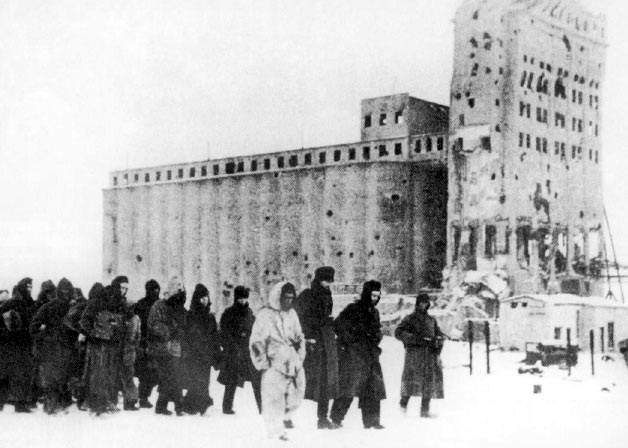
Approximately 90,000 Axis soldiers were taken prisoner. Fewer than 6,000 of them eventually returned to Germany. The rest died in Soviet captivity in the years that followed. More than half of the roughly 300,000 men trapped in the encirclement had already died from combat, wounds, cold, and starvation.
Why the disaster became unavoidable
After the defeat, German explanations focused on immediate causes: the collapse of the Romanian flanks, the weakness of the airlift, the numerical strength of the Soviet offensive, and the failure of the relief attempt. These were real factors, but they were consequences of deeper decisions.
The first major error was strategic overreach. Germany attempted to pursue the Caucasus oil fields and Stalingrad at the same time, despite lacking the forces and logistical capacity to secure both. The second was the persistent underestimation of Soviet reserves, industrial recovery, and operational planning. The third was allowing a symbolic objective to dominate military judgment.
Other errors followed from those foundations. The German command left critical flanks in the hands of allied armies whose weaknesses were known. It committed elite formations to an urban battle that consumed them without producing a decisive result. It accepted an air-supply plan that transport officers knew was unrealistic. It refused a breakout while the encirclement was still vulnerable, then failed to coordinate a rescue attempt with an attack from inside the pocket.
Finally, the command system made correction increasingly difficult. Hitler’s authority discouraged unwelcome assessments, while the officer corps’ rigid obedience discouraged independent action. A decision that might have been survivable in isolation became fatal when combined with the next decision, and then the next.
The lasting lesson of Stalingrad
Stalingrad was not simply a story of German soldiers being defeated by superior numbers. The German army retained considerable tactical skill and continued fighting for two more years. Nor were the soldiers trapped in the city responsible for the strategic decisions that placed them there.
The deeper lesson is institutional. A military organization can possess capable officers, experienced troops, and effective doctrine while still making catastrophic decisions if it loses the ability to examine its own assumptions. When leaders punish unwelcome information, when prestige becomes more important than feasibility, and when obedience replaces judgment, errors reinforce one another.
The German army did not enter Stalingrad because of one mistake. It arrived there through a chain of choices: an offensive that tried to do too much, intelligence filtered through wishful thinking, a city elevated into a test of political will, exposed flanks left unprotected, a costly failure to adapt to urban combat, and a refusal to retreat when retreat could still have saved the army.
By the time the last German resistance ended in February 1943, the result looked like a sudden collapse. In reality, the disaster had been built gradually. Stalingrad became the decisive demonstration that military competence without strategic honesty is not enough—and that an institution unable to tell itself the truth about failure may eventually be destroyed by the failures it refuses to acknowledge.