On the outskirts of Lublin, Poland, a barbed-wire perimeter once enclosed a system designed to exploit, terrorize, and kill. Majdanek began as a camp for prisoners of war and forced laborers, but it became something more expansive and more lethal: a concentration camp integrated into the Nazi genocide, equipped with gas chambers, a crematorium, and an administrative structure that turned human beings into numbers, labor units, and bodies.
Unlike many other Nazi camps, Majdanek was not successfully erased before liberation. It stood close to a major city, visible from roads and neighborhoods, and in July 1944 Soviet forces reached it before the SS could destroy most of the site. The surviving buildings and confiscated belongings offered the outside world unusually direct evidence of what had happened. The camp’s history is therefore not only a history of murder. It is also a history of visibility, documentation, and the difficult responsibility of preserving proof.
Built for Forced Labor and War Prisoners
Heinrich Himmler ordered the creation of a large camp near Lublin in the autumn of 1941. The stated purpose was to hold Soviet prisoners of war and provide a vast labor force for German construction and industrial ambitions in occupied eastern Europe. The chosen ground, in the Majdan Tatarski district southeast of the city, was flat, open, and easy to fence and patrol.
The first prisoners were forced to build the place in conditions that exposed its real priorities. They had inadequate tools, little food, and almost no protection from the Polish winter. Thousands died before the camp’s permanent structures were complete. Cold, starvation, disease, exhaustion, and deliberate deprivation were not accidental consequences of an overwhelmed institution. They were among the earliest mechanisms by which Majdanek killed.
Plans for the camp repeatedly expanded. An initial capacity of roughly 50,000 prisoners grew to 150,000 and, in some proposals, as many as 250,000. These figures far exceeded what the barracks and sanitary facilities could safely support. The gap was not simply bureaucratic incompetence. It reflected a system that treated people as disposable resources whose labor could be extracted until their bodies failed.
A Camp at the Center of a Wider Genocide
Majdanek’s function changed rapidly in 1942 as the Nazi policy of exterminating Europe’s Jews became fully organized. The Lublin district was a center of Operation Reinhard, which established the killing centers at Bełżec, Sobibór, and Treblinka. Those sites were built primarily for immediate murder. Majdanek occupied a more ambiguous but no less deadly position.
It remained a concentration and forced-labor camp, holding Soviet prisoners of war, Polish political prisoners, resistance members, Jewish prisoners, and people persecuted for other reasons. At the same time, it became part of the machinery of mass murder. Prisoners were exploited for labor while others were selected for death because they were ill, elderly, children, or otherwise deemed unable to work.
This combination made Majdanek a hybrid institution. It did not kill every arrival immediately, as a pure extermination center was designed to do. Nor was it merely a prison labor camp. It worked people to exhaustion, exposed them to starvation and disease, and used shootings and gas chambers alongside forced labor. Exploitation and extermination were not separate systems there; they reinforced each other.
Hunger, Disease, and Violence
For many prisoners, the first threat was not a gas chamber but the daily structure of deprivation. Food rations were calculated to sustain the minimum level of labor while allowing the body to deteriorate. Prisoners assigned to construction, agriculture, workshops, and outdoor labor expended far more energy than they received.
Malnutrition weakened resistance to typhus, dysentery, tuberculosis, and other diseases. Medical facilities were inadequate from the beginning and never matched the camp’s expanding population. The infirmary often functioned less as a place of recovery than as a place where the sick were separated from others and left without meaningful treatment.
Violence was both institutional and personal. Guards could beat or kill prisoners under orders, during punishments, or on arbitrary impulse. The camp’s rules created a climate in which a minor error, a visible weakness, or an encounter with the wrong guard could become fatal. Roll calls required prisoners to stand motionless for hours in heat, cold, rain, or snow. Survival depended on learning how to move, where to stand, how to avoid attention, and how to protect the small amount of strength remaining.
The Gas Chambers
In the summer of 1942, gas chambers were installed at Majdanek. The building contained chambers using different killing methods. Some were connected to external sources of carbon monoxide. A later chamber was equipped for Zyklon B, the hydrogen-cyanide compound most closely associated with Auschwitz.
Gas did not replace the older methods of killing. Hunger, disease, shootings, beatings, and exhaustion continued. The chambers added an industrial and bureaucratic method for murdering groups selected by the SS. Those judged unable to work were especially vulnerable, but the categories and procedures changed with the needs of the camp and the wider genocide.
Prisoners forced to work near the killing facilities had to remove bodies, clean the chambers, and prepare them for the next group. Their postwar testimony described the practical details with a restraint that conveys the limits of language: the time an operation took, the condition of the bodies, the work of the crematorium, and the repeated preparation for another murder.
Arrivals, Registration, and the Theft of Ordinary Life
Prisoners reached Majdanek in crowded freight cars after journeys that could last for days. There was little water, no sanitation, and almost no air. Some people died before the trains arrived. Survivors remembered corpses lying among the living when the doors opened.
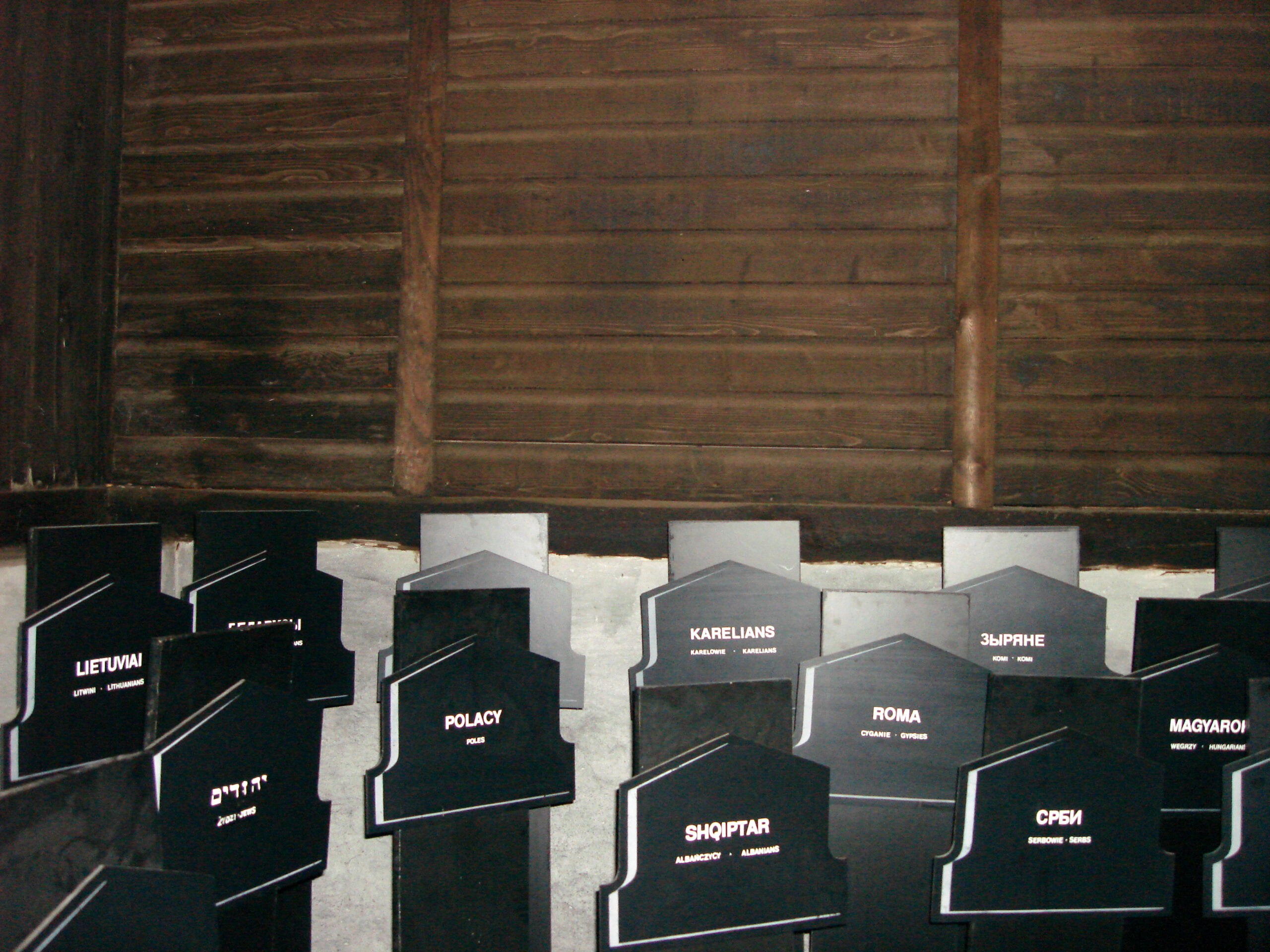
Those admitted to the camp were registered, photographed, assigned numbers, stripped of their clothing and possessions, and distributed among the barracks. Men and women occupied separate areas, while nationality and prisoner category shaped the camp’s internal organization. Wooden barracks originally designed as horse stables became overcrowded sleeping quarters with tiered bunks, insufficient blankets, and primitive sanitation.
The confiscated property revealed the scale of the crime in a way that statistics could not. Clothing, valuables, documents, shoes, toys, and other objects were sorted for reuse or shipment into the German economy. When the camp was liberated, warehouses still contained enormous quantities of these belongings. Among the most haunting were children’s shoes and small personal objects carried by people who had expected to continue living.
Operation Harvest Festival
On November 3, 1943, the SS carried out Operation Harvest Festival, known in German as Aktion Erntefest. The operation targeted Jewish prisoners held at Majdanek and nearby labor camps, including Poniatowa and Trawniki. The decision followed Jewish resistance in the Warsaw Ghetto and other uprisings, as well as the SS conclusion that the remaining Jewish labor force represented a greater perceived security risk than economic value.
At Majdanek, long trenches had been dug near the camp. Approximately 18,000 Jewish prisoners were marched from the barracks to those trenches and shot. Loudspeakers played music during the killings, an attempt to impose order and drown out the sound of the executions. The same operation unfolded at the nearby camps.
About 43,000 people were murdered across the three locations that day. It was the largest single-day massacre of the Holocaust. The scale was immense, but the method was administrative and coordinated: trenches prepared in advance, units assigned to the work, prisoners moved in stages, and the operation repeated until the targeted population had been destroyed.
The massacre did not immediately end Majdanek’s operation. Prisoners continued to arrive, the gas chambers continued to be used, and the crematorium continued to burn. But November 3 marked a decisive rupture. It showed how quickly a state could convert fear, racial ideology, logistics, and armed personnel into a synchronized act of mass murder.
People Behind the System
The camp was directed by SS officers and staffed by guards, administrators, medical personnel, and auxiliaries. Some guards came from Germany; others were recruited or compelled from occupied Soviet territories and elsewhere. Women auxiliaries exercised authority in the women’s sections. Their roles were documented in survivor testimony and postwar prosecutions.
The perpetrators were not all alike in temperament. Some were openly brutal, while others appeared restrained or ordinary in private life. What they shared was participation in an institution that made murder part of a work routine. The danger of Majdanek lies partly in that ordinariness. The camp did not depend on every participant being a sadistic aberration. It depended on ideology, hierarchy, professional obedience, material incentives, and the steady division of responsibility.
Postwar trials brought some personnel before courts, including the long Majdanek trial in Düsseldorf, which began in 1975 and examined the conduct of sixteen defendants over six years. The results were limited compared with the scale of the crimes. Some defendants were convicted, others acquitted on procedural grounds, and one died before the proceedings ended. Yet the trials created a large documentary record of testimony, evidence, and competing attempts to deny or minimize responsibility.
Liberation Before the Evidence Could Be Destroyed
As Soviet forces advanced toward Lublin in 1944, the SS evacuated many prisoners westward, sending them toward other camps, including Auschwitz. Prisoners too sick or weak to move were left behind. On July 22, Soviet units reached Majdanek, where roughly a thousand abandoned prisoners remained.
The retreat had been too hurried to erase the camp. Gas chambers, crematorium buildings, administrative offices, barracks, and warehouses survived. Investigators photographed the site, measured its structures, collected testimony, and recorded the condition of the survivors. Film and photographs circulated internationally while the war was still being fought.
Early estimates of the number killed were far higher than the figures accepted by later scholarship. Researchers eventually revised the totals by comparing transport records, camp documents, demographic evidence, physical remains, and testimony. Current estimates commonly place the total number of victims at around 78,000, including roughly 60,000 Jews, while the exact breakdown remains subject to scholarly review. The revision reflects the demands of evidence, not any reduction in the crime’s enormity.
A Memorial That Remains
Majdanek’s physical survival gives it a particular place in Holocaust history. Auschwitz was liberated months later, while the Operation Reinhard killing centers had been dismantled and concealed. Majdanek remained near a living city, with much of its infrastructure intact and its material evidence still present.
Today the site is preserved as a memorial and museum. Visitors can pass through the camp’s entrance, enter surviving barracks, see the gas-chamber building and crematorium, and stand before the mausoleum containing ashes recovered from burial pits. The warehouses and their contents make the crime tangible in a way that numerical totals alone cannot.
The shoes remain especially powerful because they belonged to individual lives. Each pair once belonged to someone who walked, worked, traveled, and expected a future. Together they show how a system that spoke in categories and totals was ultimately directed against people with possessions, relationships, fears, and plans.
What Majdanek Asks of the Present
Majdanek was visible from Lublin. Civilians could see its watchtowers, fences, smoke, and columns of prisoners. Visibility did not mean that everyone knew the full truth, nor did proximity make every resident a direct participant. But the camp complicates any easy claim that atrocities were entirely hidden from ordinary society.
Its history raises a question that extends beyond Poland and the Second World War: what does a person do when evidence of organized cruelty exists nearby? Knowledge is not the same as action, and seeing is not the same as bearing witness. The distance between the two is one of the most difficult subjects left by the camp.
The last survivors have died, as every generation of witnesses eventually must. What remains are documents, photographs, testimony, preserved buildings, and objects that resisted destruction. Their value is not only commemorative. They make denial harder by tying the historical record to a specific place and to the lives of specific people.
Majdanek was not the largest Nazi camp, nor did it claim the greatest number of victims. Its distinctive importance comes from the fact that the world saw it almost intact while the war was still underway. The gas chambers, crematorium, barracks, mass graves, and warehouses filled with confiscated belongings made a direct argument: the crime had happened, it had been organized, and it could no longer be dismissed as rumor.
Preserving that evidence is a responsibility that grows heavier as living memory fades. The site remains a warning about what happens when dehumanizing ideology is joined to administrative skill, coercive power, and the willingness of ordinary institutions to carry out extraordinary crimes.